

Table of Contents
- Reclaiming Freedom: Why Independent Travel Matters for People with Vision Loss
- The Challenge of Navigating the World with Low Vision
- How Travel Independence Evaluation Works at Florida Vision Technology
- Our Comprehensive Assessment Process
- Customized Training Programs Tailored to Your Needs
- Technology Solutions That Enable Confident Navigation
- Real-World Application: From Evaluation to Everyday Independence
- Support Throughout Your Independence Journey
- Getting Started with Your Free Evaluation
- Take the Next Step Toward Greater Mobility
- Frequently Asked Questions (FAQ)
Reclaiming Freedom: Why Independent Travel Matters for People with Vision Loss
Travel independence isn't just about getting from point A to point B. It's about reclaiming your ability to make choices, pursue opportunities, and live without constantly depending on others for navigation.
When people with vision loss can travel confidently, everything changes. They attend jobs they might otherwise miss. They run errands on their own schedule. They explore their communities without needing someone to guide them. This autonomy affects mental health, employment prospects, and overall quality of life.
We've worked with hundreds of people who believed independent travel was no longer possible for them. After proper evaluation and training with the right assistive technology, they discovered it absolutely is. The key is finding the right tools and learning how to use them effectively in your specific environment.
The Challenge of Navigating the World with Low Vision
Navigation presents real, practical obstacles for people experiencing vision loss. Sidewalk hazards, traffic patterns, unfamiliar routes, and crowded spaces all create legitimate safety concerns. These aren't imaginary barriers, and they shouldn't be minimized.
The challenge isn't just visual. It's also about confidence. Many people with low vision or blindness develop anxiety around travel because they've had negative experiences or lack structured training. Without proper preparation, even a familiar route can feel risky.
Off-the-shelf solutions rarely work for everyone. A technology that helps one person navigate might be completely unsuitable for another based on their residual vision, learning style, mobility, and lifestyle. This is why generic approaches fail. Your travel independence plan must be built specifically for you, accounting for your vision capabilities, your daily routes, and your personal goals.
How Travel Independence Evaluation Works at Florida Vision Technology
Our approach begins with understanding you, not just your diagnosis. We meet you in your actual environment, whether that's your home, workplace, school, or the neighborhoods where you travel most.
During an evaluation, we assess multiple factors:
- Your current vision capabilities and how they function in different lighting conditions
- The specific routes and environments where you need to travel
- Your comfort level with technology and learning preferences
- Any physical considerations that affect mobility
- Your lifestyle goals and what independence means to you

We conduct these evaluations for free, either at your home, workplace, or school. There's no obligation to purchase anything. Our goal is to gather the information needed to recommend realistic, personalized solutions that actually fit your life.
Our Comprehensive Assessment Process
Our assessment isn't a quick questionnaire. We work through a structured process designed to identify the right combination of tools and training for your situation.
First, we evaluate your remaining vision. Different types of vision loss affect navigation differently. Someone with peripheral vision loss faces different challenges than someone with central vision loss or light perception only. We use standardized assessments to understand your specific visual function.
Next, we observe how you currently navigate. Do you use a cane? A guide dog? Do you travel independently already, and if so, how? What works well, and where do you struggle most? Understanding your current strategies reveals where technology or training could make the biggest difference.
We also assess your comfort with different types of technology. Some people thrive with AI-powered smart glasses that provide real-time audio feedback. Others prefer smart canes that detect obstacles. Some benefit from smartphone apps combined with traditional mobility techniques. There's no single "best" solution, only the best solution for you.
Finally, we discuss your specific goals. Are you trying to get to work independently? Navigate a university campus? Travel safely through your neighborhood? The answer shapes everything about your evaluation and recommendations.
Customized Training Programs Tailored to Your Needs
Once we've evaluated your situation, we design training that actually teaches you to travel with confidence. Our programs combine orientation and mobility principles with hands-on technology training.
We offer both individualized sessions and group programs, depending on what works best for you:
- One-on-one training focuses on your specific routes, technology, and learning pace
- Group sessions let you learn alongside others facing similar challenges and build community
- Workplace or school-based training brings instruction directly to your environment
- Progressive training builds skills in structured stages, from basics to complex navigation
Our in-house staff conducts all training. They're not just reading from a manual, they understand assistive technology deeply and can troubleshoot real problems as they come up. When you're learning to navigate with new technology, having experts available makes all the difference.
Training covers both the technical skills (how to use the device) and the practical confidence (how to trust it and respond to unexpected situations). A device is only useful if you know how to use it effectively and feel comfortable relying on it.
Technology Solutions That Enable Confident Navigation

The right technology opens doors. We work with multiple solutions because different tools serve different needs.
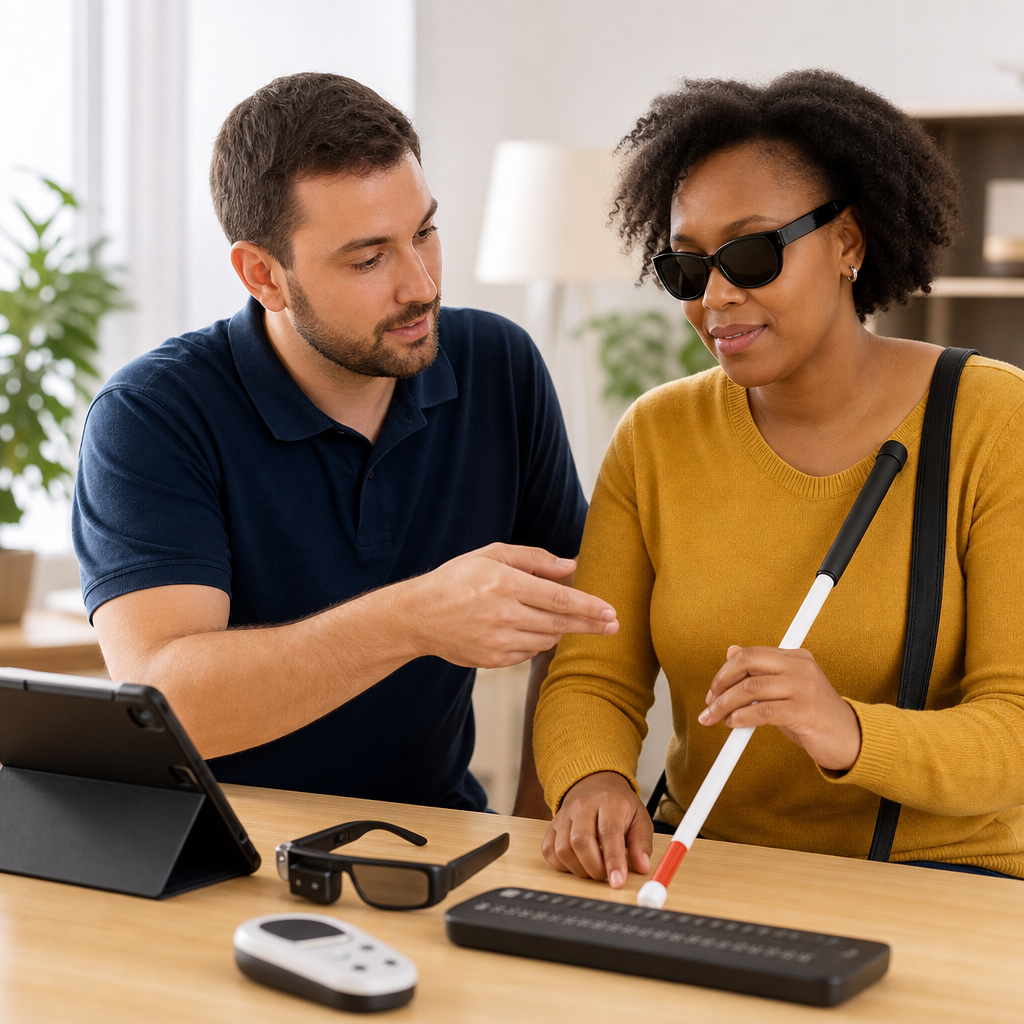
AI-powered smart glasses like OrCam, Envision, and Ally Solos provide real-time audio descriptions of your surroundings. They identify landmarks, read signs, and help you understand your environment without requiring you to hold anything or look at a screen.
Smart canes for transit and navigation use sensors to detect obstacles and provide haptic feedback, alerting you to hazards while you walk. They work alongside traditional cane techniques, not instead of them.
Smartphone-based navigation apps like Apple Maps and specialized accessible GPS tools help with route planning and turn-by-turn guidance. Many people benefit from layering multiple solutions, using an app for planning and a smart cane or smart glasses for real-time navigation.
We're an authorized Ray Ban META distributor, meaning we can provide access to these AI-integrated smart glasses and train you in their use. We also offer financing assistance through Cherry Financing, CareCredit, and the Horizon Loan Fund, because cost shouldn't be the barrier between you and technology that could transform your independence.
Real-World Application: From Evaluation to Everyday Independence
Consider how this works in practice. Marcus, a person with low vision, wanted to travel independently to his job downtown but felt anxious navigating busy streets and transit stations. During his evaluation, we identified that he retained some useful peripheral vision but struggled with detail recognition and crowd navigation.
We recommended a combination: a smart cane for obstacle detection on sidewalks and navigation training that paired that technology with structured orientation. Over eight weeks of training, Marcus learned his commute route, practiced in increasing levels of traffic, and built confidence with his device.
Now he travels independently every day. The technology isn't magic, but combined with structured training and practice in his actual environment, it gave him back control over his schedule and his life.
Another example: Sofia is blind and wanted to navigate her university campus without needing sighted help. Smart glasses that read signs and AI-powered navigation apps became her solution. She spent three months in training, first in controlled settings, then progressively on campus routes. She now moves between classes, the library, and the dining hall independently.
The pattern in every success story is the same: evaluation leads to personalized recommendations, which lead to targeted training, which leads to practiced independence. None of it happens without the evaluation phase identifying what will actually work.
Support Throughout Your Independence Journey
We don't disappear after training ends. Technical support for all products is provided by our in-house staff. If your device acts up, if you have questions about how to use it in a new environment, or if you need refresher training on certain routes, you have access to real experts who understand your specific situation.
We also support the blind and low vision community beyond individual transactions. We believe independence is built on good information, quality tools, and trained support. That's why we offer free in-person appointments and home visits, because true evaluation and training must happen where you actually live and travel.
Getting Started with Your Free Evaluation
Taking the first step is straightforward. Contact us to schedule your free evaluation. We'll visit your home, school, or workplace at no cost. We'll listen to what you're trying to accomplish and honestly assess what might help.
You'll receive specific recommendations based on your situation. If you decide to move forward, we'll help you understand financing options and get you set up with training. If you decide to explore other options first, that's fine too. Our goal is helping you make informed decisions about your independence.
Take the Next Step Toward Greater Mobility
Independent travel is possible. It requires honest evaluation, realistic planning, the right technology, and structured training. We've helped hundreds of people reclaim this independence, and we're here to help you too.
Reach out to Florida Vision Technology to schedule your free evaluation. Whether you're interested in smart glasses, smart canes, navigation apps, or a combination of solutions, we'll help you find the right path forward. Your independence is worth the investment.
About Florida Vision Technology Florida Vision Technology empowers individuals who are blind or have low vision to live independently through trusted technology, training, and compassionate support. We provide personalized solutions, hands-on guidance, and long-term care; never one-size-fits-all. Hope starts with a conversation. 🌐 www.floridareading.com | 📞 800-981-5119 Where vision loss meets possibility.
Frequently Asked Questions (FAQ)
What does our independent travel evaluation include?
We conduct a thorough assessment of your current mobility skills, daily navigation challenges, and lifestyle goals. Our evaluation process includes testing various assistive technologies in real-world environments and identifying which solutions work best for your specific needs. We also evaluate your home, workplace, or school to understand the spaces where you spend most of your time.
How much does it cost to get an evaluation and training?
Our initial assistive technology evaluations are completely free, whether you choose to meet us at our office or we visit you at home, school, or work. We also offer financing options through Cherry Financing, Care Credit, and the Horizon Loan Fund to make devices and training programs accessible to you. All our in-person appointments and home visits are at no cost to you.
Will the training prepare me to travel independently in my daily life?
Yes, our customized training programs are designed specifically around your real-world activities and environments. We teach you how to confidently use the technology we recommend and practice in actual locations you navigate regularly. Our in-house technical support team continues to assist you after training, ensuring you can maintain and troubleshoot your devices as you gain independence.