

Table of Contents
- The Cost Barrier to Vision Independence
- Understanding Government Grant Programs for Assistive Technology
- Federal Funding Sources We Help You Navigate
- State and Local Grant Opportunities Available
- How Our Team Guides You Through the Application Process
- Financing Solutions Beyond Government Grants
- Our Free Evaluations Help Maximize Your Funding
- Success Stories From Clients We've Helped Secure Funding
- Next Steps to Access Vision Technology Today
- Frequently Asked Questions (FAQ)
The Cost Barrier to Vision Independence
Advanced vision technology transforms daily life for people with low vision and blindness. Smart glasses like the Vision Buddy Mini and OrCam can read text, recognize faces, and navigate spaces independently. Braille tablets and video magnifiers restore access to information. Yet these devices often cost between $3,000 and $15,000, creating a real barrier for many individuals and families.
We understand that cost shouldn't prevent you from accessing technology that increases independence. Fortunately, government grants, state programs, and alternative financing exist specifically to help. Many people don't know these options are available, or they feel overwhelmed by application processes. That's where we step in to guide you.
The truth is straightforward: funding pathways exist, but they require knowledge and persistence to navigate successfully. We've helped dozens of clients secure grants and financing they didn't know they qualified for. Your financial situation shouldn't determine your access to independence.
Understanding Government Grant Programs for Assistive Technology
Government grants for assistive technology work differently than traditional loans or scholarships. They're designed to remove financial barriers for people with disabilities, with no repayment required. These programs exist at federal, state, and local levels, each with different eligibility requirements and funding amounts.
The key concept is that assistive technology is considered a reasonable accommodation under the Americans with Disabilities Act (ADA). This legal framework means employers, schools, and government agencies have obligations to fund or help fund technology that enables equal access. Understanding this foundation helps explain why these funding sources exist and why you may qualify.
Most grants fall into three categories: vocational rehabilitation funding (for work-related devices), educational funding (for school-age individuals), and general disability support programs. Each has distinct application timelines and benefit limits. We help you identify which category applies to your situation and what documentation you'll need.
Start by understanding your primary goal: are you seeking technology for employment, education, daily living, or a combination? This answer determines which funding sources align best with your needs and increases your approval likelihood.
Federal Funding Sources We Help You Navigate
The Rehabilitation Services Administration (RSA) Vocational Rehabilitation program stands as the largest federal funding source for assistive technology. If you're working or seeking employment, your state's vocational rehabilitation agency can fund devices that enable job performance. Eligibility requires a documented visual impairment and a vocational goal.
We guide clients through the RSA application by helping them clearly document how specific technology supports their work objectives. For example, if you're a data analyst seeking eSight glasses to read on-screen information independently, we'll help articulate how this device removes job barriers and increases productivity. The Vocational Rehabilitation office wants to see clear connections between the technology and employment outcomes.

The Individuals with Disabilities Education Act (IDEA) provides another major federal pathway. If you have school-age children with visual impairments, your school district must provide assistive technology as part of their individualized education program (IEP). This means evaluations, devices, and training are funded at no cost to families.
For adults, Social Security's Supplemental Security Income (SSI) Work Incentives program includes Plans to Achieve Self-Support (PASS). This allows you to set aside income or resources specifically for assistive technology purchases without affecting benefits. It's particularly valuable for people managing work toward financial independence.
We also work with clients pursuing funding through the American Foundation for the Blind (AFB) and other national nonprofits that maintain grant databases and occasionally fund individual technology purchases. These sources are more competitive but worth exploring, particularly if federal programs have limited availability.
State and Local Grant Opportunities Available
Every state maintains vocational rehabilitation agencies with different funding levels, wait lists, and technology approval timelines. Florida's Division of Vocational Rehabilitation is robust, but availability varies by county and funding year. We help you understand your state's specific programs and current funding status.
Beyond vocational rehabilitation, many states offer independent living programs specifically designed to fund assistive technology for people with disabilities. These programs prioritize devices that increase daily living independence: video magnifiers, braille displays, and smart canes. Eligibility typically doesn't require employment goals, making these programs accessible to a broader population.
County and municipal programs add another layer. Some communities maintain assistive technology lending libraries where you can trial devices before purchase. Others offer direct grants through disability services departments. We research your local options and help you compile a comprehensive funding strategy that layers multiple sources.
Local nonprofits focused on vision loss often maintain smaller grant programs or partnerships with technology companies. Organizations like state chapters of the National Federation of the Blind frequently have member resources and technology assistance funds. We maintain connections with these organizations and refer clients to aligned programs.
Don't overlook specialized programs tied to specific causes of vision loss. If you have diabetic retinopathy, for instance, diabetes organizations sometimes fund vision technology. If you're a military veteran with service-related vision loss, veterans' benefits include substantial assistive technology funding. We help you identify programs aligned with your specific situation.
How Our Team Guides You Through the Application Process
The application process itself often deters people from pursuing funding they qualify for. Forms require medical documentation, vocational goals, cost estimates, and letters of support. Our team handles much of this complexity for you.
We start with a professional assistive technology evaluation at your home, school, or workplace. This evaluation does double duty: it identifies the best technology for your needs and generates clinical documentation that funding agencies require. Evaluations are completely free through our practice.
Once we identify the right device, we provide detailed cost estimates and clinical justifications that explain why this specific technology addresses your functional limitations. Funding agencies want to see that you're not requesting general equipment but specific devices that meet documented needs. Our documentation uses language that resonates with grant reviewers.
We also help you compile supporting documentation: your medical records, vocational goals, letters from employers or educators, and proof of financial need (if required). Many applications fail simply because documentation is disorganized or incomplete. We ensure everything is properly formatted and submitted on deadline.
For vocational rehabilitation applications specifically, we coordinate with your vocational counselor to ensure alignment. We explain how the assistive technology removes specific job barriers and increases productivity, which is the language rehabilitation agencies use when evaluating requests.
Financing Solutions Beyond Government Grants
Not every funding need aligns perfectly with government grants. Wait lists exist, deadlines pass, and some programs have limited annual budgets. We offer multiple financing pathways to bridge gaps or serve as alternatives.
Cherry Financing and Care Credit provide promotional financing for medical and assistive technology purchases. These options often include interest-free periods if paid within a specified timeframe, making them manageable for families. We handle applications and explain terms clearly so you understand your payment obligations.
The Horizon Loan Fund specifically serves people with disabilities seeking assistive technology. They offer below-market interest rates and longer repayment periods than traditional loans, recognizing that these devices increase earning capacity and independence over time. Qualification is often easier than bank loans because the lender understands disability-related financial situations.
We accept all major credit cards and work with you to structure purchases that align with your budget. Some clients combine sources: securing a government grant for one device while financing another through Cherry Financing. This layered approach accelerates your path to independence.
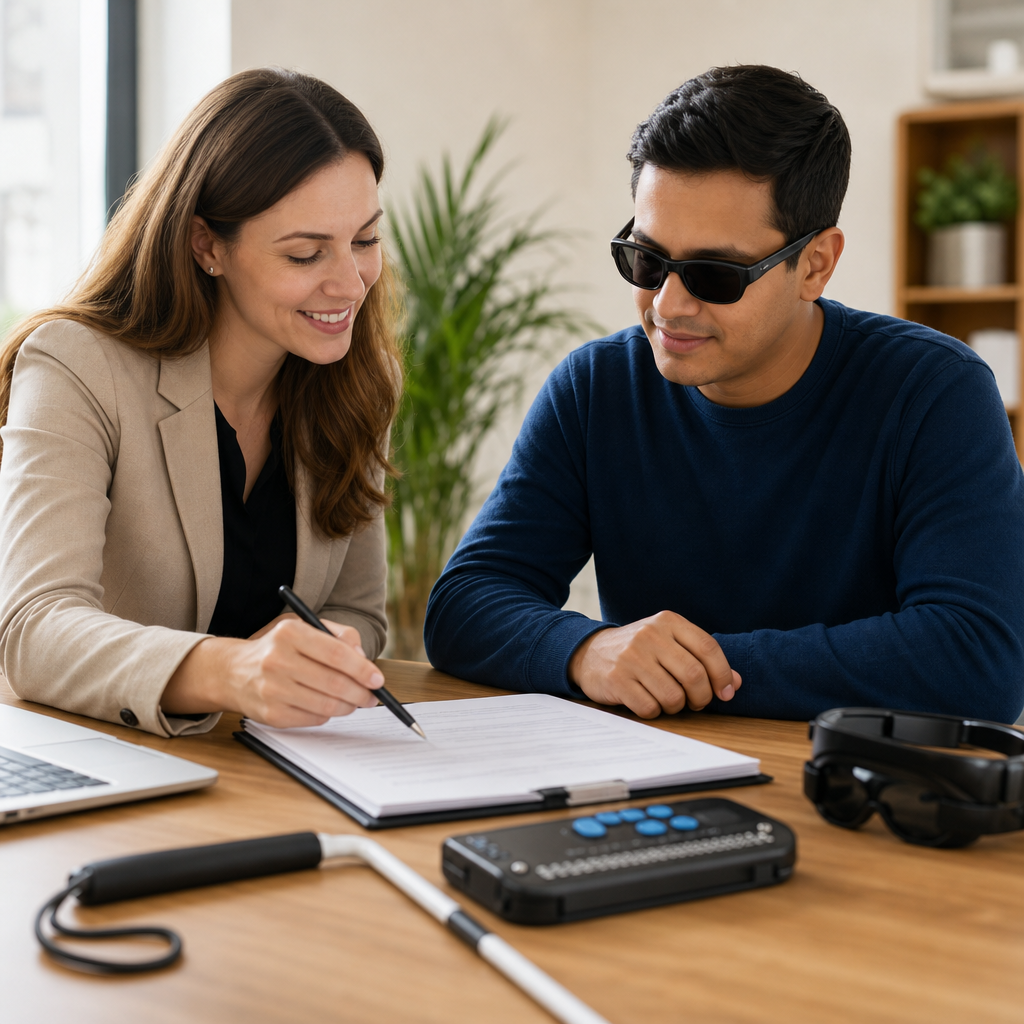
Exploring financing options for braille technology and other assistive technology purchases shows you real scenarios where clients combined multiple funding sources. These examples illustrate how creative financing often opens doors faster than waiting for a single grant.
Our Free Evaluations Help Maximize Your Funding
Every client we work with starts with a free assistive technology evaluation. This isn't a sales pitch; it's a clinical assessment that identifies which devices genuinely match your needs, lifestyle, and goals.
Why does this matter for funding? Grant agencies and lenders want documentation that justifies specific technology recommendations. Our evaluation provides exactly that. We measure your functional vision, test you with multiple devices, assess your learning style, and document why particular technology solves your challenges. This clinical foundation strengthens every funding application you submit.
We conduct evaluations in your preferred location: home, workplace, school, or our office. We understand that traveling for appointments is sometimes difficult, so we bring equipment to you and spend time understanding your actual environment. This contextual assessment produces better recommendations than office-based testing alone.
Our evaluations also identify whether you need multiple devices working together. Some people benefit from smart glasses for mobility and a braille tablet for detailed reading. Other situations call for a video magnifier and voice technology. We help you understand the complete technology solution your specific situation requires, which prevents you from undershooting your funding requests.
Success Stories From Clients We've Helped Secure Funding
Maria, a paralegal, experienced progressive vision loss that threatened her career. She could no longer read documents on-screen despite font enlargement. Through vocational rehabilitation, we helped secure $8,000 in funding for Vision Buddy Mini glasses plus training. Her evaluation documented how the device restored her productivity and job security. She's now three years into a promotion and uses her technology daily.
James, a high school student with congenital cataracts, needed technology for classroom success. We worked with his school district's special education department, using our evaluation to demonstrate that a combination of video magnification and braille technology would maximize his academic access. The school approved $12,000 in assistive technology purchases without family cost-sharing.

Patricia sought independent living support after age-related macular degeneration left her unable to read mail or manage finances independently. Through a state independent living grant, she received funding for a combination of a video magnifier and voice-enabled smart home technology. Our home evaluation identified her specific daily challenges and shaped grant recommendations that genuinely transformed her daily life.
These aren't exceptional cases. They represent the standard outcome when people access appropriate funding and technology paired with proper training. The common factor across every success story is that clients took the first step: reaching out to explore their options.
Next Steps to Access Vision Technology Today
Start by scheduling your free assistive technology evaluation. Contact us through our website at https://www.floridareading.com or call to discuss your situation. During this initial conversation, we'll understand your goals, vision status, and financial circumstances.
Bring any existing medical records documenting your vision loss. If you're pursuing vocational rehabilitation or educational funding, gather information about your employer's HR contact or your school's special education coordinator. These details help us coordinate with funding agencies from the start.
We'll conduct your evaluation, identify the best technology solutions, and immediately begin discussing funding options with you. If government grants apply, we'll explain requirements and timelines. If alternative financing makes sense, we'll walk you through those options too.
You don't need to navigate funding complexity alone. Our team has guided hundreds of clients from uncertainty to technology that genuinely increases independence. Your next step is simple: reach out and let us help you access the vision technology you deserve.
About Florida Vision Technology Florida Vision Technology empowers individuals who are blind or have low vision to live independently through trusted technology, training, and compassionate support. We provide personalized solutions, hands-on guidance, and long-term care; never one-size-fits-all. Hope starts with a conversation. 🌐 www.floridareading.com | 📞 800-981-5119 Where vision loss meets possibility.
Frequently Asked Questions (FAQ)
What government grants does Florida Vision Technology help clients access?
We help our clients navigate federal programs like the Rehabilitation Services Administration (RSA), state vocational rehabilitation agencies, and vocational rehabilitation programs that fund assistive technology devices. We also guide clients through grants specific to their state and local disability services organizations. Our team stays current on available funding sources so we can match each client with programs they qualify for based on their specific vision needs and circumstances.
Do you offer financing if I don't qualify for government grants?
Yes, we provide multiple financing solutions for clients who don't receive government funding or need additional support. We accept all major credit cards and work with Cherry Financing, Care Credit, and the Horizon Loan Fund to make our devices and services accessible. We can discuss payment plans during your free evaluation so cost never prevents you from getting the technology that increases your independence.
How does your free evaluation help with funding?
Our in-home or workplace evaluations identify exactly which devices will work best for your vision needs and daily activities, which is critical information for grant applications. We provide detailed documentation and recommendations that strengthen your funding requests to government programs and lenders. This thorough assessment ensures that whatever funding source you pursue, you're requesting technology that will genuinely improve your independence and access.